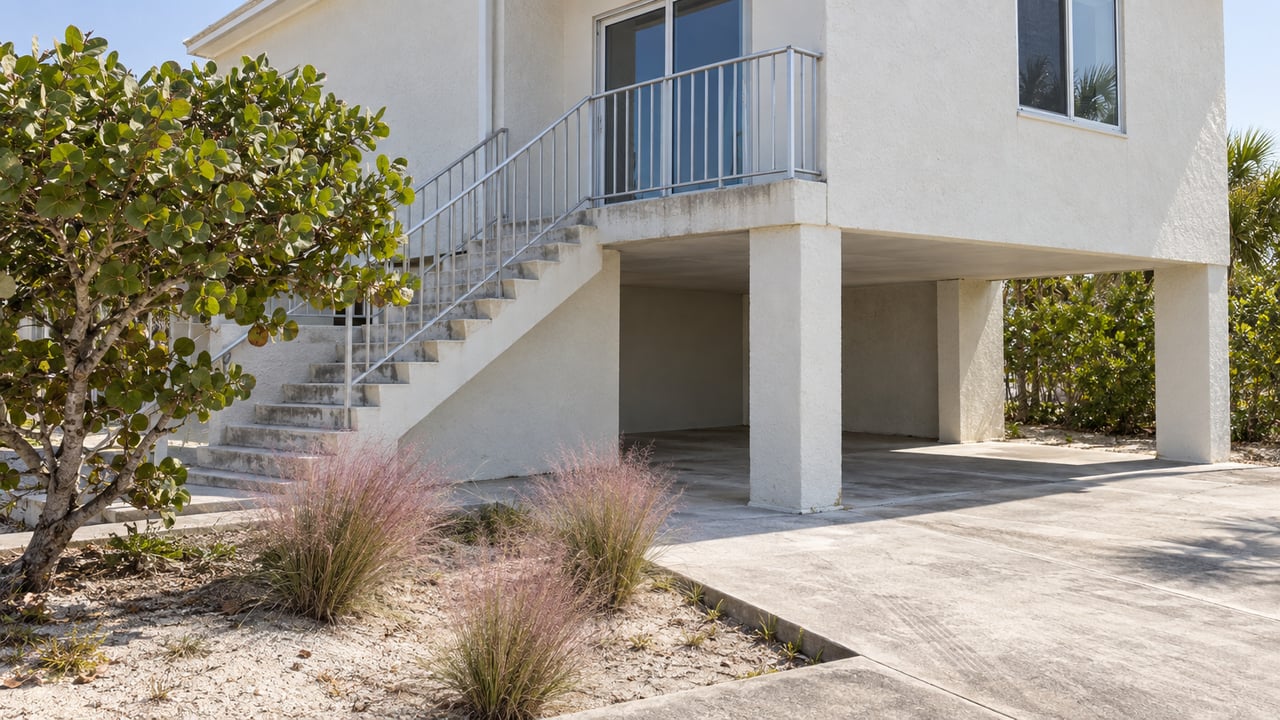
The Line You Can't See Is Deciding How High Manasota Key Can Rebuild
October 1, 2026
October 1, 2026
Two houses on Manasota Key can sit less than a mile apart, share the same gulf-to-bay orientation, and still answer to completely different rulebooks the day either one needs a permit. The reason has nothing to do with flood zone maps or storm history. It comes down to which county drew the line under the parcel. Manasota Key runs roughly twelve miles from Venice at its north end down to Stump Pass at its south end, and partway down that stretch, the island crosses from Sarasota County into Charlotte County. Each county writes its own floodplain rules, and as of late 2024, those rules stopped looking anything alike.
For a buyer comparing two similarly priced homes on the key, that split is the detail that actually determines what you can rebuild, how high you can go, and what your insurance conversation looks like five years from now. It rarely shows up on a listing sheet.
Hurricanes Helene and Milton hit Manasota Key and neighboring Sandpiper Key hard in the fall of 2024, and Charlotte County spent the following months rewriting its zoning overlay for both islands in response. The county commission approved the new code that November, and it did something most flood ordinances don't: it set a freeboard requirement well above the state minimum, and it set it differently depending on which flood zone your parcel sits in.
Under the new Charlotte County rule, a single-family home in flood zones AE or X on the key needs five feet of resilient freeboard beneath the finished floor. That takes a home's overall allowed height from 38 feet to 43 feet. A home in the VE, Coastal A, or Seaward zones needs seven feet of freeboard, pushing the allowed height to 45 feet. Compare that to the baseline most of the region still runs on: the Florida Building Code requires one foot of freeboard above base flood elevation, and a 2023 review by county staff found that outside of Charlotte's new overlay, only the City of Bradenton Beach had gone further than that baseline in this part of the coast. Charlotte County didn't nudge the number. It moved from one foot to as much as seven, and only for these two islands.
Sarasota County, which governs the northern stretch of the key near Venice along with the mainland side of Englewood, never adopted anything close to that jump. Its own floodplain ordinance still requires the lowest floor to sit at or above base flood elevation, the Florida Building Code minimum, or one foot above the local flood study's projected stage, whichever is highest. That's the standard freeboard math most Gulf Coast buyers already expect. It is not the five-to-seven-foot standard now written into Charlotte County's Manasota and Sandpiper Key overlay.
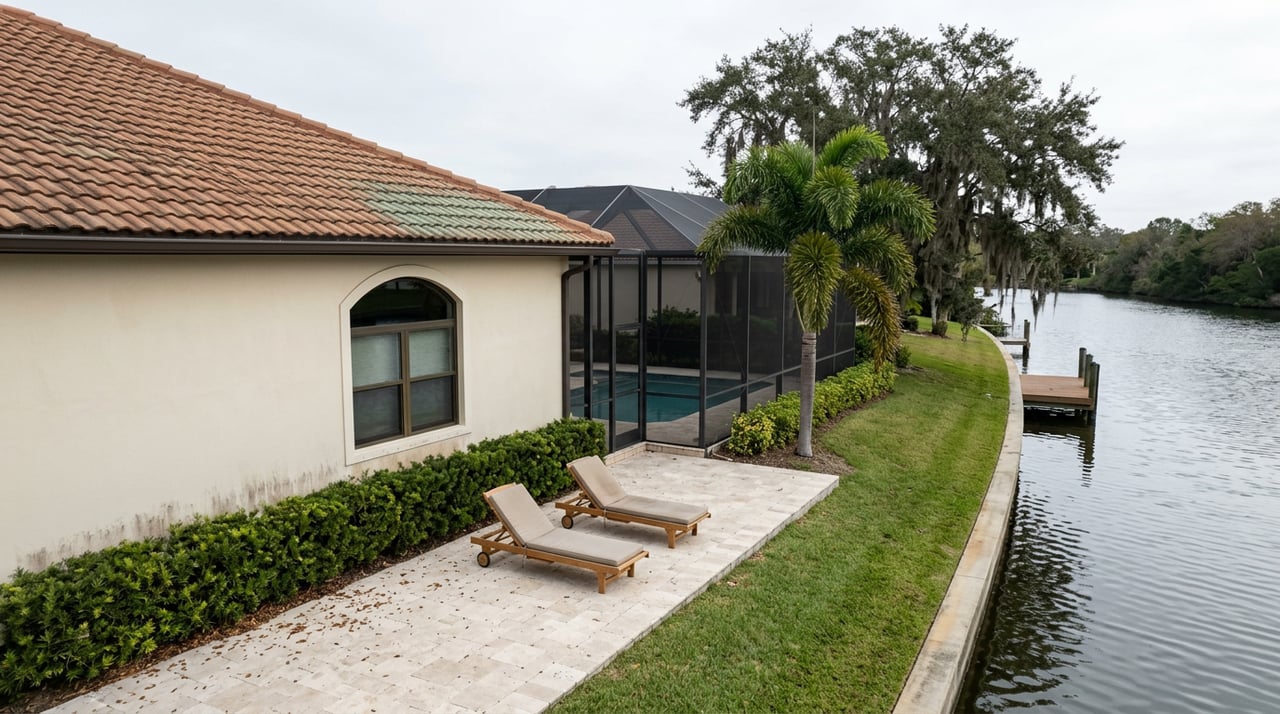
So the same island, marketed under one name, currently runs two different rebuild ceilings depending on where the county line falls beneath a given lot.
None of this matters until a home crosses a specific damage threshold, and that threshold is not local. Under the National Flood Insurance Program, once a structure's damage or planned improvements reach 51 percent of its market value, federal and state rules require the entire building to come up to current floodplain code, no matter what the local zoning said the week before the storm. A Charlotte County commissioner made this point directly during the November 2024 hearing: once a structure crosses that 51 percent line, FEMA, the Florida Department of Environmental Protection, and the state building code take precedence over whatever the county's own zoning allowed.
That's the mechanism that turns an abstract ordinance into a real number on a renovation estimate. A home just under the threshold can patch, repair, and stay at its current elevation. A home just over it has to be lifted, and lifted according to whichever county's freeboard rule applies to that parcel. On the Charlotte County side of the key, that could mean adding five to seven feet of pilings under a home that used to sit close to grade. Residents pushed back hard on the speed of the change. Damian Ochab, president of the South Manasota Sandpiper Key Association, asked county officials during deliberations, "Why not provide a temporary, two-year waiver?" The county moved ahead with the new code anyway, citing the federal and state mandates it had to satisfy regardless.
Older homes face a separate wrinkle. County commissioner and builder Bill Truex noted during the same hearings that some homes built in the 1970s can't be elevated at all given how they were originally constructed, which turns the 51 percent threshold into a much bigger decision for those owners than a simple renovation budget.
A year after Milton, the recovery on the ground was still visible and uneven. Reporting from Manasota Key in October 2025 found empty lots where homes once stood next to properties nearing the end of repairs, and business owners still describing softer traffic than before the storms. Willy Townsend, who runs the White Elephant Pub on Englewood Beach, put it simply when asked what the community needed going into the next season: "We are like a family here." Longtime residents like Lori Johannessen described neighbors helping each other dig out and rebuild, while acknowledging some homes on the key are gone for good.
The physical coastline is also mid-repair. Charlotte County has scheduled a second full-scale beach and dune renourishment project for Manasota Key, with construction currently estimated to start November 23, 2026, and wrap by the following April, including dune restoration near Chadwick Cove Beach Park close to Englewood Beach. The project follows the same design template used in the 2019-2020 renourishment and is meant to rebuild the buffer that storm surge and six named storms since 2022 have worn down, though county officials are clear it won't make the island storm-proof.
Against that backdrop, the market itself has settled into a steadier rhythm heading into 2026. After a few years of fast sales and thin inventory, local market commentary points to a more measured pace this year, with more time for buyers to evaluate a property before committing and more attention paid to details like seawall condition and dock infrastructure on waterfront lots. That patience is worth extending to the county line question too. It's the kind of detail a fast market makes easy to skip and a measured one gives you the room to actually check.
The parcel's specific flood zone and jurisdiction matter more than the general reputation of "the key" as a whole. A title company or surveyor can confirm which county's floodplain code applies to a specific address, and Charlotte County maintains an elevation certificate database for structures built in the Special Flood Hazard Area going back to 1984, with earlier records available in some cases. That certificate is also what an insurance agent needs to give an accurate quote rather than an estimate based on the surrounding zone.
Before assuming a property's current footprint or height is protected long term, it's worth asking directly whether any past damage claims exist on the home and how close, if at all, the structure has come to that 51 percent substantial improvement threshold. A seller's disclosure should cover prior flood claims under Florida law, but a direct conversation about renovation history fills in what a disclosure form sometimes leaves vague.
Does the county line affect insurance premiums today, or only future rebuilds? The freeboard rule itself only applies when a home is newly built or crosses the substantial improvement threshold. Current premiums are driven by the home's existing elevation certificate and flood zone, but a property that will eventually need to meet the higher Charlotte County standard carries different long-term rebuild risk than one that would only need to meet Sarasota County's baseline.
How do I find out which county governs a specific Manasota Key address? A title search or a call to the county property appraiser's office will confirm jurisdiction for a specific parcel. Since the key crosses from Sarasota County near Venice into Charlotte County further south, don't assume based on the property's general location on the island.
Is the whole key still recovering from the 2024 storms? Recovery has been uneven. Some stretches show completed repairs and reopened businesses, while other lots remain vacant more than a year later. The scheduled 2026-2027 beach renourishment project is aimed at restoring the dune system that took the brunt of the storm damage, not rebuilding individual homes.
If you're comparing properties on Manasota Key or anywhere else along Englewood's coastline and want to know exactly which flood rules apply to a specific address before you write an offer, reach out to Christine Walker. She'll help you pull the right records before you're standing at a closing table trying to figure it out.
Stay up to date on the latest real estate trends.
Real Estate
Real Estate
Real Estate
Get assistance in determining current property value, crafting a competitive offer, writing and negotiating a contract, and much more. Contact me today.