One Roofline, Two Prices: What Holmes Beach's Seaside Gardens Rebuild Rule Means for Buyers
August 27, 2026
August 27, 2026
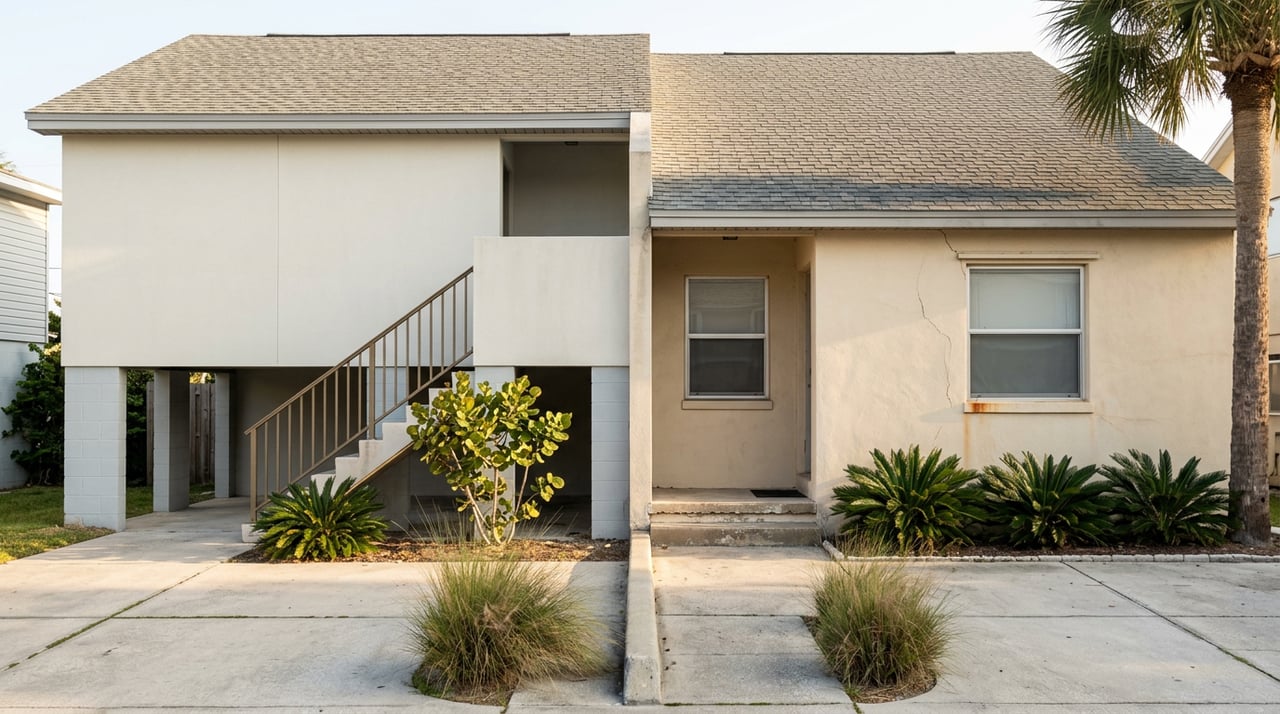
Walk the interior streets of Seaside Gardens on Anna Maria Island today and you'll see something that shouldn't be possible in a neighborhood of shared-wall townhomes built in the 1960s. One unit of a triplex sits up on new pilings, freshly elevated, with parking tucked underneath. The unit attached to it, sharing the same roofline and the same party wall, still sits at grade, exactly as it was built six decades ago. Same address block. Same lot type. Two very different buildings under one continuous roof.
That split is not an accident of construction timing or a homeowner who simply had more money. It is the direct, visible result of a zoning mechanism the city of Holmes Beach adjusted in 2023 and is actively rewriting again this year. If you're comparing property in this pocket of the island, understanding that mechanism matters more than the comps you'll find on a portal, because it explains why two units that look nearly identical on paper can carry very different insurance bills, appraised values, and resale trajectories.
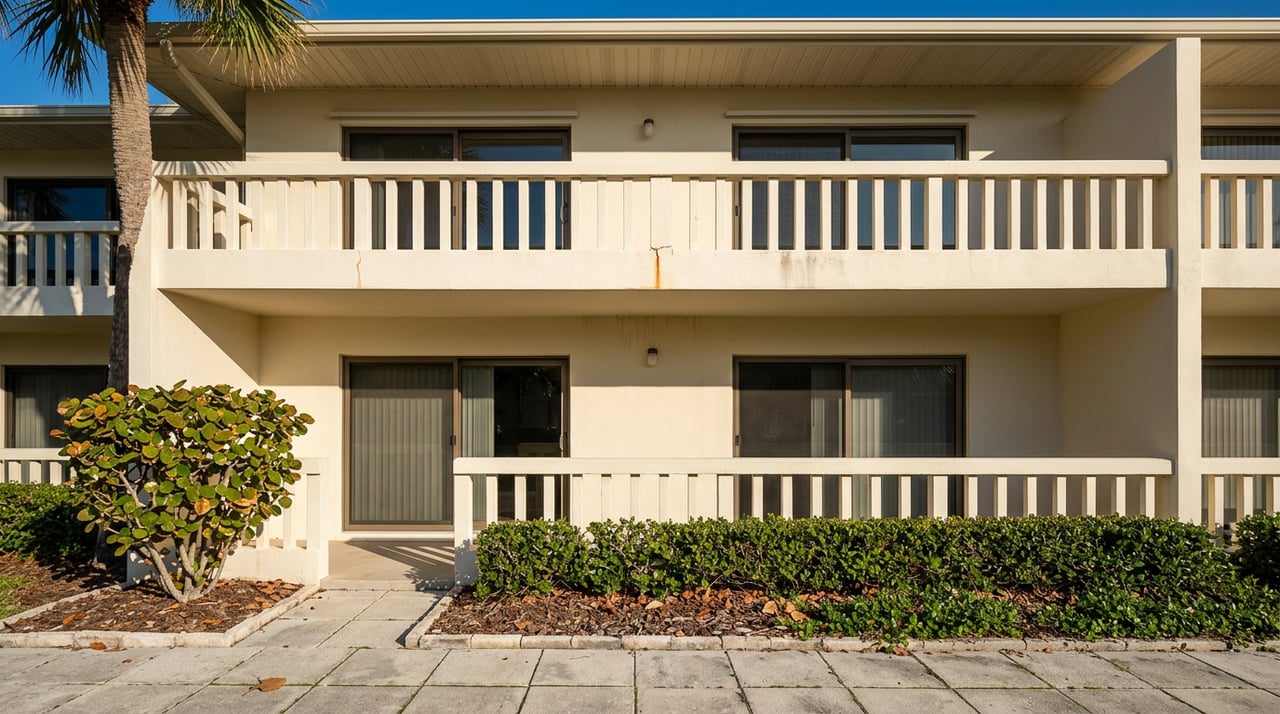
Seaside Gardens traces back to the early 1960s, when developer John E. Holmes Sr., the namesake of the city itself, laid out roughly 104 individually owned ground-level duplex, triplex, and five-plex units on cinder block foundations with shared party walls and common roofs. The community sits in the city's R-4 medium-density residential district, and nearly all of it predates the base flood elevation standards that now govern new construction on the island.
That history is exactly why the neighborhood has spent the last few years wrestling with a problem most Florida coastal subdivisions never have to solve at this scale: what happens when a homeowner wants to tear down and rebuild to current flood code, but the unit is physically attached to a neighbor who doesn't want to, or can't afford to, do the same thing at the same time.
In September 2023, the city commission adopted Ordinance 23-19, which allowed a Seaside Gardens townhome to be rebuilt to current floodplain standards only if it had been involuntarily damaged to 50 percent or more of its market value. That threshold matters because the market value used in the calculation is not the sale price or the tax assessment. City staff have an independent appraiser value the structure alone, separate from the land, and run that figure through a formula the building official applies before any rebuild permit is approved.
At the time that first ordinance passed, most Seaside Gardens homeowners were not in favor of allowing voluntary reconstruction, only involuntary rebuilds after real storm damage. That changed. At the neighborhood's annual homeowners meeting on February 9, 2026, a majority of residents in attendance told city staff they now wanted the ability to rebuild voluntarily too, storm damage or not.
Development Services Director Chad Minor brought a draft response to the city commission at its February 24, 2026 work session: Ordinance 26-03, which would let owners demolish and rebuild a nonconforming, non-storm-damaged unit on a voluntary basis, provided the new structure is built like-for-like in compliance with FEMA and the city's floodplain rules, without adding footprint or creating new nonconformities. According to the most recent public reporting available on the measure, it was headed to a first reading on March 10, 2026, followed by a planning commission review before any final adoption vote. If you're evaluating a specific unit today, the smart move is to call the city's Development Services Department directly and ask where that ordinance stands, because a zoning rule in motion changes what you can and can't do with the property you're about to buy.
Here's the part that actually moves value: because the rebuild right attaches to an individual unit's appraised structure value, not to the building or the block as a whole, one half of a duplex can clear the 50 percent threshold and qualify for a rebuild while its attached neighbor, built the same year with the same materials, does not. City staff have already confirmed this is happening on the ground. In one active project, one side of a Seaside Gardens duplex is being replaced with an elevated townhome with ground-level parking below, while the other half remains at grade. A separate Seaside Gardens triplex has one unit currently being elevated while its neighbors have not moved.
Median sale prices in Seaside Gardens climbed sharply year over year through the community's most recent reporting period, rising more than 30 percent to roughly $550,000. That number is real, but it is easy to misread. A single median across a neighborhood where some units are 1960s ground-level cinder block and others are brand-new, three-level, FEMA-compliant construction with elevators and rooftop decks isn't describing one market. It's averaging two.
That bifurcation is the actual story for anyone shopping here in 2026. An unrebuilt, ground-level unit and a freshly elevated unit two doors down are not substitutes for each other, even though a portal search might list them side by side under the same subdivision name. The ground-level unit carries the flood exposure, the insurance cost, and the uncertainty of when its own rebuild rights might trigger. The elevated unit carries a construction price tag, but also the insurance and financing advantages that come with meeting current code. Pricing either one off the neighborhood median alone will mislead you in either direction.
Flood insurance in Florida is no longer priced to a community average. Under the National Flood Insurance Program's Risk Rating 2.0 methodology, a policy is priced to the specific building, its elevation, and its flood zone, not to the subdivision it sits in. That single design choice is what makes the Seaside Gardens split so consequential for a buyer. Two attached units on the same lot type can carry meaningfully different flood premiums the moment one side's elevation certificate changes and the other's does not, and that gap shows up again at resale, when a lender's underwriting looks at the specific structure, not the neighborhood it belongs to.
For owners who want to pursue elevation without waiting for a qualifying loss, Florida's Elevate Florida program, administered by the state's Division of Emergency Management, offers a cost-share that can cover a significant share of an eligible elevation project, including for duplexes and townhomes. It's a resource worth knowing about whether you're the one buying the unit that still needs the work, or negotiating price against a seller who hasn't done it.
If a unit in Seaside Gardens, or any similarly built party-wall community on Anna Maria Island, is on your list, a few questions will tell you more than the listing photos can.
Does a rebuild on one side of a duplex affect the value of the attached unit that stays as-is? It can cut both ways. An elevated neighbor can support a higher comp for future resale, but it can also mean years of adjacent construction and a harder conversation with your own insurer about how the shared structure is now classified.
Is Seaside Gardens unique, or does this pattern show up elsewhere on the island? Seaside Gardens is the clearest example because its ordinance history is so well documented, but any older party-wall or common-roof community built before current flood elevation standards on Anna Maria Island faces a version of the same math.
If you're looking at property in Seaside Gardens or anywhere else on Anna Maria Island where a unit's rebuild history matters as much as its square footage, Christine Walker can help you pull the right questions together before you write an offer, not after.
Stay up to date on the latest real estate trends.
Real Estate
Real Estate
Real Estate

Get assistance in determining current property value, crafting a competitive offer, writing and negotiating a contract, and much more. Contact me today.